


Designing Better Workplaces Through Independent Thinking with Design Colab


As workplaces continue to evolve, furniture procurement has become far more than selecting desks and chairs—it is now a strategic investment in business performance, employee wellbeing, and long-term sustainability. Organisations are seeking flexible, people-centred environments that reflect their culture while supporting productivity, collaboration, and the changing ways in which people work. In this landscape, the role of independent FF&E (Furniture, Fixtures and Equipment) specialists has never been more important.
Design Colab has established itself as a leading independent FF&E consultancy, offering clients an objective, tailored approach to workplace procurement. Free from the limitations of representing a single manufacturer or furniture brand, the company curates bespoke solutions from an extensive network of trusted local and international suppliers. By placing the client’s objectives at the centre of every decision, Design Colab delivers commercial interiors that balance exceptional design, functionality, sustainability, performance, and value.
In this exclusive interview, Véga Stevenson, Head of Furniture and Procurement at Design Colab, shares how the company’s independent approach is transforming commercial interiors. From navigating complex procurement challenges and embracing sustainable sourcing to creating flexible, future-ready workplaces and launching an innovative new showroom, Stevenson offers valuable insights into the trends shaping the future of workplace design and why thoughtful furniture selection has become a critical driver of business success.
Design Colab positions itself as an independent FF&E consultancy rather than a traditional furniture supplier. How does this independence influence the way you approach each project, and what advantages does it offer clients?
Design Colab FF&E consultancy positions itself as an independent partner for businesses seeking tailored furniture procurement and workplace solutions. Rather than being tied to a single manufacturer or supplier, Design Colab delivers objective recommendations based on each client’s unique requirements, ensuring every solution supports both business goals and workplace performance.
We’re not tied to a factory, a brand, or a dealership agreement, which means we can build a supplier network around what a project actually needs and what our clients value, rather than what one manufacturer’s catalogue has to offer. Many of our suppliers are B-BBEE accredited, and Design Colab itself is a Level 1 B-BBEE contributor.
It also removes the classic dealer-designer conflict of interest. Consolidating procurement under one independent partner cuts out overlapping supplier margins and simplifies project administration, and because we’re not tied to one brand, specification decisions are driven purely by fit, budget, and performance. Our supplier relationships also help with pricing, sample turnaround, and accelerating delivery where possible.
We start by understanding the business, the people using the space, the design intent, and the project’s commercial objectives. From there, we curate the right furniture solution from a broad network of trusted local and international suppliers. That independence gives our clients confidence that every recommendation is based on what’s genuinely best for their workplace, not what happens to be sitting in a catalogue.
It also allows us to remain flexible. Every project has different priorities, whether that’s budget, lead times, sustainability, performance, or aesthetics. Because we’re not tied to a single brand, we can respond to those priorities while maintaining a cohesive, high-quality outcome.
Every commercial workspace has its own culture, operational needs, and design vision. How do you balance aesthetics, functionality, budget, and long-term performance when curating furniture solutions for a project?
We treat those four as one brief rather than four separate conversations. Functionality comes first because it’s what determines whether a space actually works day to day. Budget shapes sequencing rather than cutting quality across the board. Longevity is where procurement is often undervalued, so we prioritise it early, including on the reuse side. Many projects start with a site audit of existing furniture to identify what can be retained, refurbished, or reupholstered locally, with anything that can’t be reintegrated being donated rather than sent to landfill. That’s often the biggest lever for both budget and sustainability at once.
The best workplace furniture is never chosen simply because it looks good. It needs to support the way people actually work. Furniture should be a long-term investment. Durability, maintenance requirements, warranties, adaptability, and lifecycle costs all contribute to the real value of a solution.


With workplace expectations evolving rapidly, what are the most significant trends you are seeing in commercial interiors, and how are they shaping the future of office furniture procurement and workplace design?
A few things are converging right now. Demand for residential-style office environments keeps growing. Organisations are designing around people rather than simply fitting people into offices, so furniture is becoming more flexible, modular, and adaptable, with employee wellbeing and comfort front of mind.
Accessibility and inclusive design are also becoming a bigger part of the brief. Clients want spaces and furniture that work for everyone using them, not just the average user.
Sustainability has moved from a soft preference to a measurable line item. Clients increasingly want furniture with a longer lifespan and responsibly sourced materials. Multinational clients, in particular, commonly ask for Green Star ratings, and we work with a factory that holds Green Star accreditation to help meet that requirement when needed.
Design Colab manages the entire FF&E journey, from sourcing and budgeting to installation and aftercare. What are some of the biggest challenges in delivering large-scale commercial projects, and how does your project management approach ensure a seamless outcome?
One of the biggest challenges is coordination. Furniture procurement involves manufacturers, suppliers, logistics providers, installers, designers, contractors, and the client team. On a large project, that can mean coordinating fifteen to twenty suppliers alone. If communication breaks down at any point, it can affect the entire project.
That’s why project management sits at the heart of what we do. We manage the full FF&E journey, from budgeting and specification through procurement, production tracking, quality control, delivery, installation, and aftercare.
Planning ahead is also critical. Many commercial furniture items have significant manufacturing and shipping lead times, so early procurement planning helps minimise programme risk and ensures clients receive exactly what was specified, on time and within budget.
Lead times are another challenge, particularly for imported items. Geopolitical issues in the Middle East have contributed to recent import delays. Imported furniture is sourced primarily from Europe when required, and it typically arrives through the ports of Durban or Cape Town. South Africa’s local manufacturing base has matured enough that this is less of a constraint than it used to be. Our default is to find a local match first, including for ISO, BIFMA, ergonomic, or Green Star specifications, and in most cases one exists. Where importing is still the right option, we keep clients informed of realistic delivery programmes and propose alternatives where stock availability or lead times are at risk.


Looking ahead, what is your vision for Design Colab, and how do you see the role of independent FF&E specialists evolving as businesses place greater emphasis on flexible, sustainable, and people-centred workspaces?
The market data backs up what we’ve believed operationally for more than ten years and over four hundred projects: sourcing decisions are now a genuine lever for corporate performance, not simply a back-office task. Furniture procurement is no longer just about purchasing products. It’s about creating environments that help businesses perform.
So, we believe the role of independent FF&E specialists will become increasingly strategic. As green certification economics continue to improve and clients demand documentation to support ESG claims, specialists who hold suppliers accountable to a brief, rather than a catalogue, become even more valuable.
As independent consultants, our responsibility is to help clients navigate an increasingly complex market, providing objective advice, managing risk, and delivering furniture solutions that continue adding value long after project completion.
That’s the future we see for Design Colab FF&E consultancy: remaining a trusted partner that combines commercial insight, technical expertise, and thoughtful workplace strategy to create environments where people and businesses can thrive.
Your latest showroom reflects Design Colab’s philosophy and approach to contemporary workplace design. What was the vision behind the space, and how does it demonstrate the importance of thoughtful furniture selection, collaboration, and user experience in today’s commercial interiors?
We wanted to create a space that demonstrates how people actually work today, rather than simply displaying furniture in a traditional showroom setting.
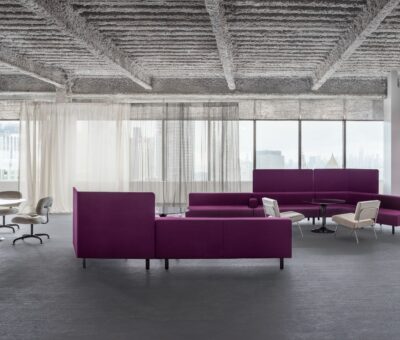
Every area has been designed to showcase different workplace experiences, from focused work and collaboration to informal meetings. It allows clients, designers, and project teams to experience furniture within a realistic workplace environment and understand how different products perform together.
The showroom also reflects our collaborative approach. It brings together products from around fifteen key suppliers, demonstrating how independent specification allows us to create cohesive solutions that aren’t limited to a single supplier.
Ultimately, it’s a working environment that starts conversations. Clients can see, test, compare, and experience solutions before making important investment decisions, which leads to better outcomes for everyone involved.
We applied the same material-led FF&E strategy we use on projects, giving equal weight to comfort and durability rather than favouring one over the other for display purposes. We leaned into softer, residential-inspired forms, layered textures, and acoustic thinking that responds to how people actually work day to day.
We recently hosted our launch event with industry professionals and look forward to hosting more events and networking opportunities soon.
Contact:
Design Colab.
You might also like.


You might also like...
-
Knoll: Reframing the Workplace with Dividends Skyline

The office is no longer a static environment defined by desks and partitions. It has become something more fluid, more atmospheric—an ecosystem that must accommodate ...
-
Kehls Patterned Chenille Fabrics: How to Use Bold Chenille Fabrics

After years of safe, solid neutrals dominating the scene, bold, tactile prints are having a well-deserved moment. And when that pattern comes in chenille? It’s ...
-
Beyond Beige: Finding Your Office Style for a More Productive Workspace | Modern Office

When it comes to designing an office style for a productive workspace, many environments still default to safe, neutral tones and uninspired layouts. However, Modern ...
-
Infinity Surfaces: Porcelain Surfaces for Indoor & Outdoor Living

The shift into warmer days often brings a renewed appetite for change at home. Curtains are pulled back, doors open onto patios and terraces, and ...


Visit SA Decor & Design on social media


